What's the Best Way to Design Landscaping Around a Sloped Property?
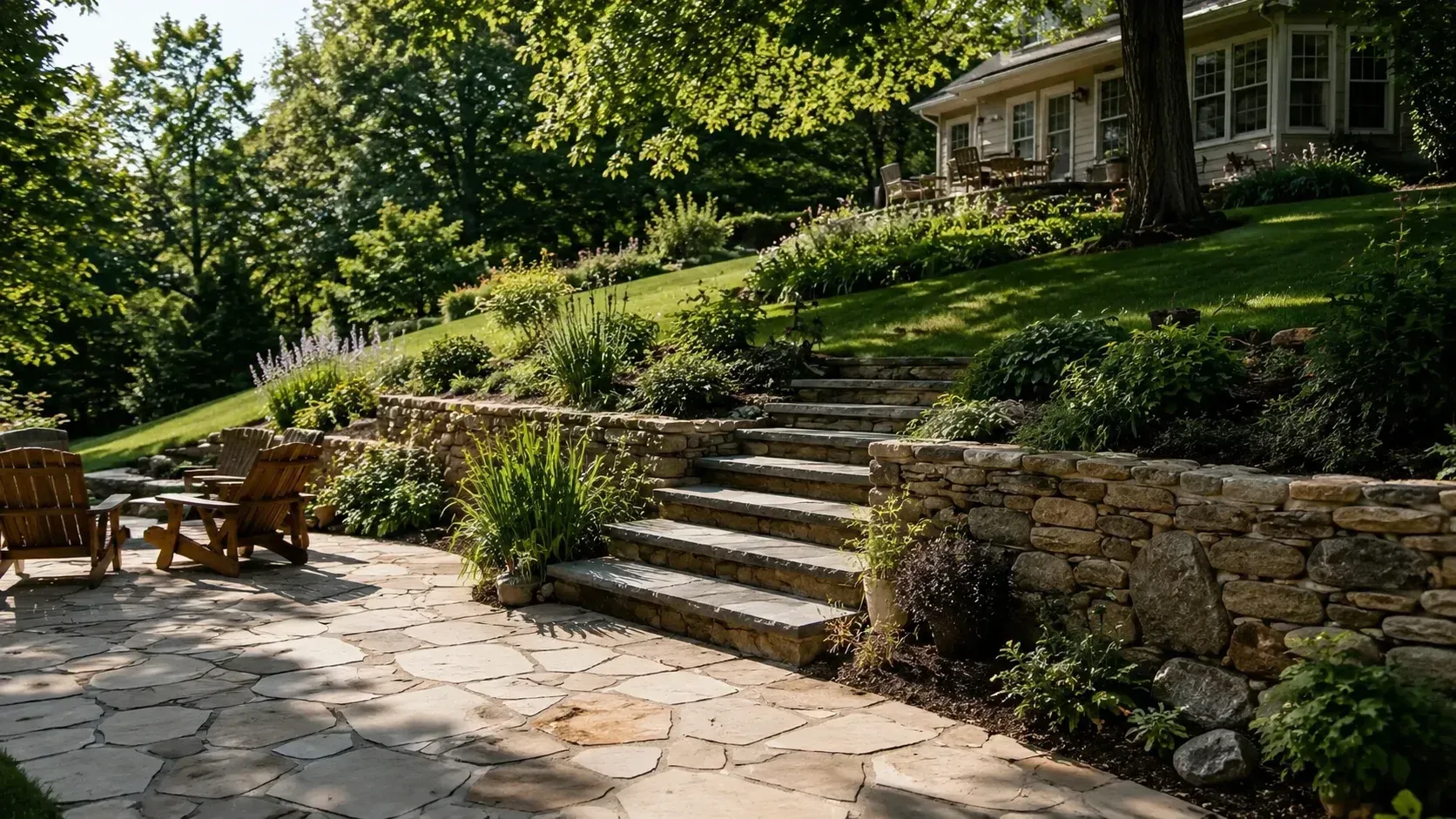
Table of Contents
- Introduction
- Why Slopes Change Everything About a Yard
- Start With Water, Not Plants
- The Main Design Approaches for a Sloped Yard
- A Simple Framework for Deciding
- Choosing Plants That Actually Hold a Slope
- Common Misunderstandings About Hillside Landscaping
- What Typical Online Advice Overlooks
- Conclusion
- Frequently Asked Questions
Key Takeaways
- The best design for a sloped property starts with managing water and stabilizing soil, then builds planting and features on top of that foundation.
- Terracing, retaining walls, and deep-rooted plants are the three tools most often used to control erosion and make a slope usable.
- Gentle slopes can often be handled with plants and grading, while steeper grades usually need engineered structures.
- Drainage mistakes, not plant choices, cause most slope failures, so water should be planned before anything is planted.
- The right approach depends on the grade, soil type, budget, and how you want to use the space, so there is no single correct answer for every yard.
Introduction
The best way to design landscaping for a sloped property is to control water and stabilize the soil first, then shape the land into usable areas using terracing, retaining walls, or deep-rooted plantings suited to the grade. On a gentle slope, thoughtful grading and ground cover may be enough, while steeper yards usually call for structural support. If you are planning a project in the Bitterroot Valley, working through the details with an experienced landscape design team can help you match the method to your specific grade, soil, and goals before any digging begins.
This matters because a slope is not just a flat yard tilted at an angle. Water moves faster, soil erodes, and poor planning shows up quickly as gullies, settling, or a retaining wall that leans. Getting the sequence right, water first and plants last, is what separates a slope that holds up for decades from one that needs repair in a few seasons.
Why Slopes Change Everything About a Yard
A sloped yard behaves differently from a flat one in three important ways: water runs off instead of soaking in, gravity constantly pulls soil downhill, and access becomes harder for both people and equipment.
On flat ground, rainwater tends to sit and absorb. On a slope, that same water gains speed as it travels, and moving water carries soil with it. Over time this creates channels, exposes roots, and can undercut foundations or hardscape. The steeper the grade, the more force the water carries.
Slope is usually described as a ratio or a percentage. A yard that drops one foot for every four feet of horizontal distance is a 25 percent grade, which is considered steep for landscaping. Anything above roughly 33 percent (a one-to-three drop) is generally difficult to work by hand and often needs engineered solutions. Knowing your approximate grade is the first practical step, because it drives nearly every decision that follows.
Start With Water, Not Plants
Direct answer: On any sloped property, drainage should be planned before planting or building, because uncontrolled water is the single most common cause of slope failure and erosion.
Most people picture plants or a patio when they imagine a finished slope. Professionals tend to picture where the water goes first. If runoff is not directed and slowed, even the best-looking planting will eventually wash out.
Common water-management tools on a slope include swales (shallow shaped channels that redirect flow), French drains (gravel-filled trenches with perforated pipe), and dry creek beds that carry and slow water while looking intentional. Downspouts from the house also need attention, since concentrated roof runoff onto a slope is a frequent trouble spot.
The goal is not to stop water but to control its speed and path. Slower water drops the soil it is carrying and soaks in rather than cutting channels. This principle is consistent with guidance from soil conservation resources such as the USDA Natural Resources Conservation Service, which emphasizes slowing and spreading runoff to reduce erosion.
The Main Design Approaches for a Sloped Yard
There are three core strategies for sloped yard landscaping, and many projects combine them. Each suits a different grade and budget.
Terracing breaks a long slope into a series of flat, stepped levels, similar to wide stairs. Each level is usually held by a low wall or a planted edge. Terracing creates usable flat space for gardens, seating, or lawn, and it dramatically slows water by interrupting its downhill run. It tends to be labor-intensive and therefore more costly, but it turns an unusable hillside into functional space.
Retaining walls hold back soil to create a level change in one step rather than several. Short walls under about three or four feet are often straightforward, but taller walls hold enormous pressure and typically require engineering, proper drainage behind the wall, and sometimes permits. A retaining wall without drainage behind it is one of the most common failure points in hillside projects. This is where hardscaping work overlaps heavily with slope design.
Planting-based stabilization uses deep-rooted grasses, shrubs, and ground covers to knit the soil together. Roots act like natural rebar, and a dense planting can handle gentle to moderate slopes without heavy structures. This is usually the least expensive approach, but it takes time to establish and is not enough on its own for steep grades.
A Simple Framework for Deciding
When homeowners ask which approach is right, the honest answer is that it depends on a few measurable factors. This framework walks through them in order.
| Factor | Gentle slope (under ~15%) | Moderate slope (~15 to 33%) | Steep slope (over ~33%) |
|---|---|---|---|
| Typical method | Plants, ground cover, light grading | Terracing or short retaining walls | Engineered walls, professional design |
| Erosion risk | Lower | Moderate | High |
| DIY feasibility | Often reasonable | Limited | Rarely advisable |
| Drainage planning | Recommended | Important | Essential |
| Likely cost | Lower | Medium | Higher |
To use it, work through these questions in sequence:
- What is the approximate grade? Measure the vertical drop over a set horizontal distance.
- Where does water currently flow, and where does it pool? Watch the yard during a rainstorm if you can.
- How do you want to use the space? A vegetable garden, a play area, and a low-maintenance planted bank all lead to different designs.
- What is the soil like? Sandy soil drains fast but erodes easily; clay holds water and can slide when saturated.
- What is the budget and timeline? Structural solutions cost more up front but may prevent costly repairs later.
No single option is universally correct. A steep bank you never walk on might be best left as a stabilized planted slope, while a moderate grade near a patio might justify a retaining wall.
Choosing Plants That Actually Hold a Slope
Plant selection for hillside landscaping ideas should prioritize root depth and spread, not just appearance. The plants that stabilize a slope are the ones whose roots reach down and outward to bind soil.
Deep-rooted native and adapted plants are usually the strongest choice in the Hamilton, MT area because they tolerate the local climate, including cold winters and dry summers, without constant irrigation. Ground covers, ornamental grasses, and many shrubs establish dense root systems that resist erosion. Turf grass, by contrast, has shallow roots and is a poor choice for holding a steep bank.
A few practical planting principles for slopes:
- Group plants by their water needs, and place thirstier plants lower where moisture collects.
- Use mulch or erosion-control matting on bare soil until plants fill in, since young plantings do not protect soil yet.
- Avoid leaving large areas of exposed dirt over winter, when freeze and thaw cycles loosen soil.
Because plant hardiness varies by region, checking your zone through a resource like the USDA Plant Hardiness Zone Map is a sensible step before buying anything.
Common Misunderstandings About Hillside Landscaping
Common belief: A retaining wall alone will fix a slope.
What is actually true: A wall without proper drainage and a stable base often fails, because water pressure builds behind it.
Why it matters: Spending money on a wall while ignoring drainage can lead to leaning, cracking, or collapse within a few years.
Common belief: More plants always mean less erosion.
What is actually true: Only well-rooted, established plants stabilize soil, and newly planted slopes are actually vulnerable until roots take hold.
Why it matters: The first year after planting is when erosion control matting and mulch matter most, and skipping them undoes the effort.
Common belief: Steeper slopes just need a stronger version of the same DIY approach.
What is actually true: Beyond a certain grade, slope work becomes a structural and safety issue that benefits from engineering.
Why it matters: Underbuilt structures on steep ground can fail suddenly, and failures near a home are expensive and sometimes dangerous.
What Typical Online Advice Overlooks
Most quick guides focus on the visible parts, the walls and the plants, and skip the parts that determine success. A few frequently ignored considerations:
Maintenance over time is rarely discussed. A planted slope needs weeding and occasional replanting until it fills in, and drains need to be kept clear of debris. A design that looks finished on day one still requires care through its first seasons.
Long-term water behavior is often underestimated. Runoff patterns can change as nearby construction, tree growth, or new downspouts alter where water travels. A slope design should account for how water will behave in future years, not only today.
Opportunity cost matters too. Money spent over-building a slope you rarely use might be better directed elsewhere in the yard. The most functional plan weighs how you actually live in the space against how much structure the grade genuinely requires. For homeowners weighing several outdoor priorities at once, reviewing the full range of landscaping services available locally can help set sensible priorities.
Conclusion
Designing landscaping for a sloped property comes down to a clear order of operations: manage water, stabilize the soil, then build the usable and planted space on that foundation. Gentle slopes often respond well to grading and deep-rooted plants, while moderate and steep grades usually need terracing or engineered retaining walls with proper drainage behind them.
The right answer for any given yard depends on measurable factors, the grade, the soil, the drainage, the budget, and how the space will be used. There is no universal solution, and the most durable results come from matching the method to those conditions rather than copying a single idea seen elsewhere. Understanding these trade-offs puts you in a strong position to plan a slope that stays stable and useful for years.
Planning a Sloped Yard in Hamilton, MT? Start With the Right Questions
If you are considering landscaping for a sloped property in the Hamilton, MT area, the most useful next step is a conversation about your specific grade, soil, and goals. A local team familiar with Bitterroot Valley conditions can help you understand your options, weigh the trade-offs, and decide what fits your yard and budget, with no pressure and no obligation to move forward before you are ready.
Frequently Asked Questions
How steep is too steep to landscape without a retaining wall?
Slopes steeper than roughly a one-to-three grade (about 33 percent) usually need structural support like retaining walls or engineered terracing. Gentler slopes can often be stabilized with grading and deep-rooted plants, though drainage still needs planning.
What is the cheapest way to landscape a sloped yard?
Planting deep-rooted ground covers, grasses, and shrubs is typically the lowest-cost method, since it avoids heavy structures. It works best on gentle to moderate slopes and takes time to establish, so mulch or erosion matting is needed while plants take hold.
Do I need drainage if I install a retaining wall?
Yes. Drainage behind a retaining wall is essential, because trapped water builds pressure that can crack, lean, or topple the wall. Most wall failures trace back to missing or inadequate drainage rather than the wall material itself.
What plants are best for holding soil on a slope?
Deep-rooted, regionally adapted plants work best, including native grasses, ground covers, and shrubs whose roots bind soil. Turf grass is a poor choice for steep banks because its shallow roots do little to prevent erosion.
Can I landscape a sloped yard myself?
Gentle slopes are often manageable for homeowners using plants and light grading. Moderate to steep slopes, tall walls, and significant drainage work usually benefit from professional design, both for safety and to avoid costly failures.
Recent Posts